
By: I Gede Putu Rahman Desyanta, CEO of Baliola (Part One of Three Articles)
(The following article was published on the Bekraf website)
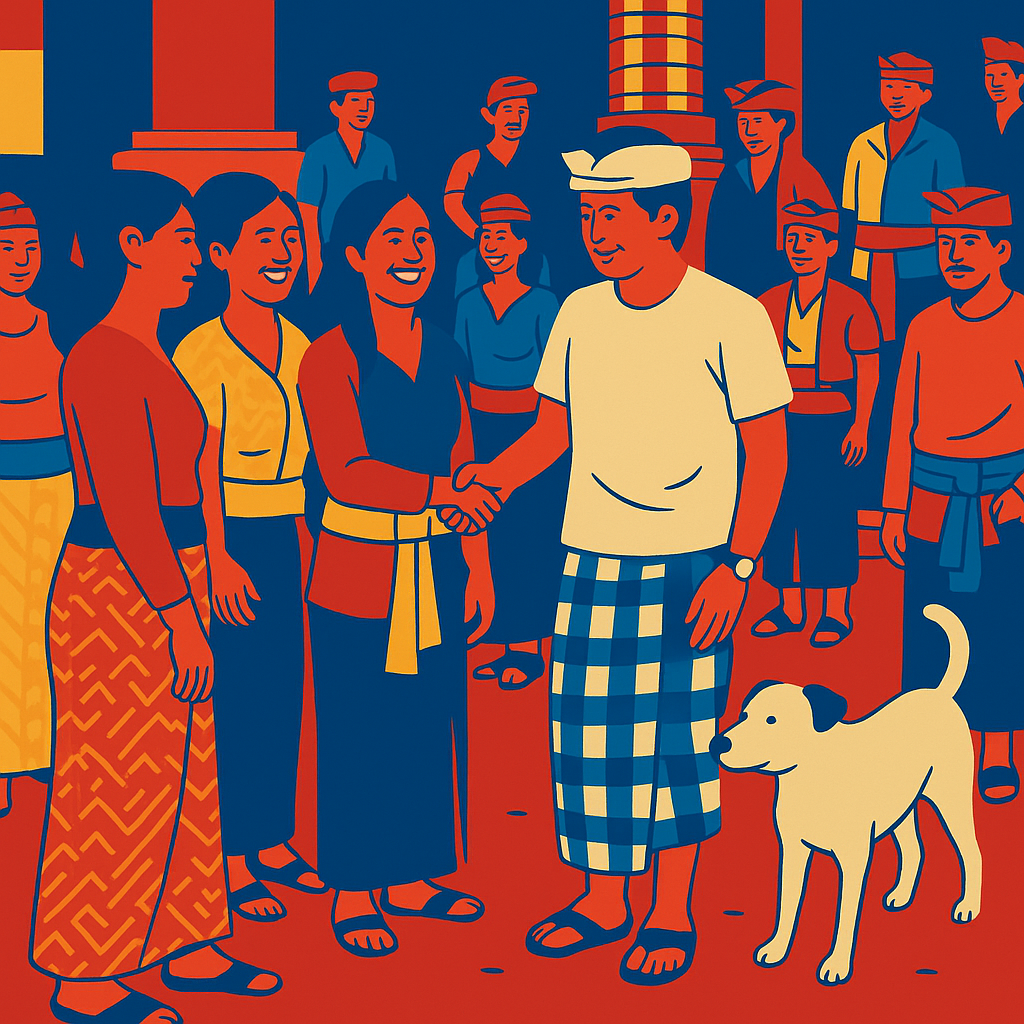
Imagine a peaceful afternoon in a Balinese village. Beneath the shade of frangipani trees, elders sit cross-legged, chatting, children run around carefree, and everyone greets each other with genuine smiles. No one feels like a stranger, because everyone feels part of one big family. Not because of blood ties, but because of shared values: mutual trust, mutual help, and mutual respect.
This is the true face of Menyama Braya—the spirit of togetherness that has sustained Balinese society across generations. This value is not just a cultural slogan, but a living, breathing part of daily life that binds individuals into a cohesive, participatory, and meaningful social system.
However, today, our social spaces are shifting. From bale banjar (village halls) to WhatsApp groups, from traditional markets to online marketplaces, from face-to-face interactions to screen-to-screen communication. The digital world has become our new habitat. But sadly, not all values have transitioned with us.
In the digital world, we can be connected without truly knowing each other. We can speak without feeling responsible for our words. We can build things, but also destroy them—with just one click.
In the flood of connections, we have lost something that used to be so deeply ingrained: a sense of shared belonging, trust, and human connection. We live in an expansive network, but without meaningful bonds. Yet, at the heart of Menyama Braya lies one vital element: trust.
The Erosion of Trust in the Digital World
Trust is not just a moral element—it is the practical foundation of a healthy society. Without trust, there can be no mutual cooperation, no helping hands, and no meaningful social collaboration. In the physical world, trust grows from eye contact, shared sweat, and collective experiences. But in the digital world, everything must be rebuilt—without bodies, without physical spaces, and sometimes, without names.
The digital world promises connection, but often delivers alienation. We open apps, share data, transact, and leave digital footprints without truly feeling seen, understood, or protected. Every day we click, scroll, and upload, but what we build is no longer braya (a community), but merely profiles and notifications.
Speed replaces depth. Convenience replaces sensitivity. And slowly, trust fades.
The Crisis of Relationships in Cyberspace
The biggest problem of the digital era isn’t just data security or the spread of misinformation. The deepest problem is the crisis of relationships: the loss of trust as the foundation of togetherness. We don’t know who holds our personal data. We don’t know if our digital creations truly belong to us. And we don’t know if the information we read is reality or manipulation.
We are asked to trust, but not given the tools to verify.
Yet, Menyama Braya teaches the opposite. That relationships are built on shared experiences and transparency. That trust is born from consistency and recognition. Without trust, the digital world becomes just a transactional space: transactional, not social; pragmatic, not participatory.
It’s no wonder more and more people feel lonely amidst thousands of digital connections. We are connected to the entire world, but lose orientation in our own lives.
So, the crucial question now is: Will the digital space remain an empty place without meaning, or can it become a new home for our values of togetherness?
If Menyama Braya once thrived in villages and customary communities, it now needs to find its digital form—not to replace the past, but to survive and thrive in the future.
We can’t go back to the past, but we can carry its values into the future. We can’t stop the wave of digitalization, but we can decide what values we bring with it.
And at this point, we need to rebuild the trust system—a new social system in digital format, one that is not just fast and sophisticated, but also fair, open, and rooted in our cultural values.
A Human-Centered Digital World
The first step is realizing that technology is not neutral. It can amplify inequality, or it can empower noble values. It all depends on how we design and use it.
Menyama Braya must not stop at the bale banjar. It must walk with us into the digital spaces—becoming an ethic, a structure, and a spirit in every system we build. Because without trust, the digital world will only become a cold and empty jungle of notifications.
But if we succeed, then the digital space won’t just be a place for connections, but a place for growing together, sharing values, and building a future that is not only efficient but also meaningful.
And for that, we need to continue this conversation—about the core values of Menyama Braya, and how those values can become a new framework for building a fair and human-centered digital world.
To be continued in Part 2: “Menyama Braya and the Five Pillars of Togetherness in the Cyber Era”